Blake Franke · 21 September 2026
Celestial Mechanics Shape Bloom Timelines for Rare Floral Hybrids
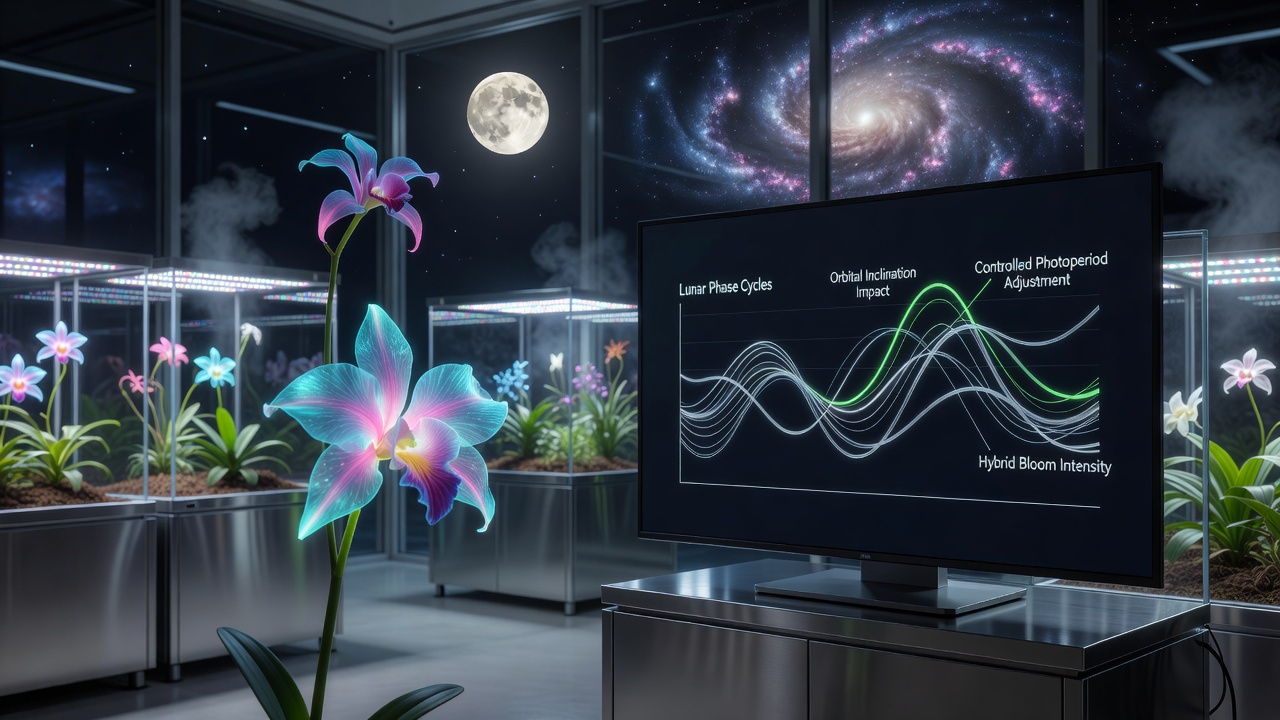
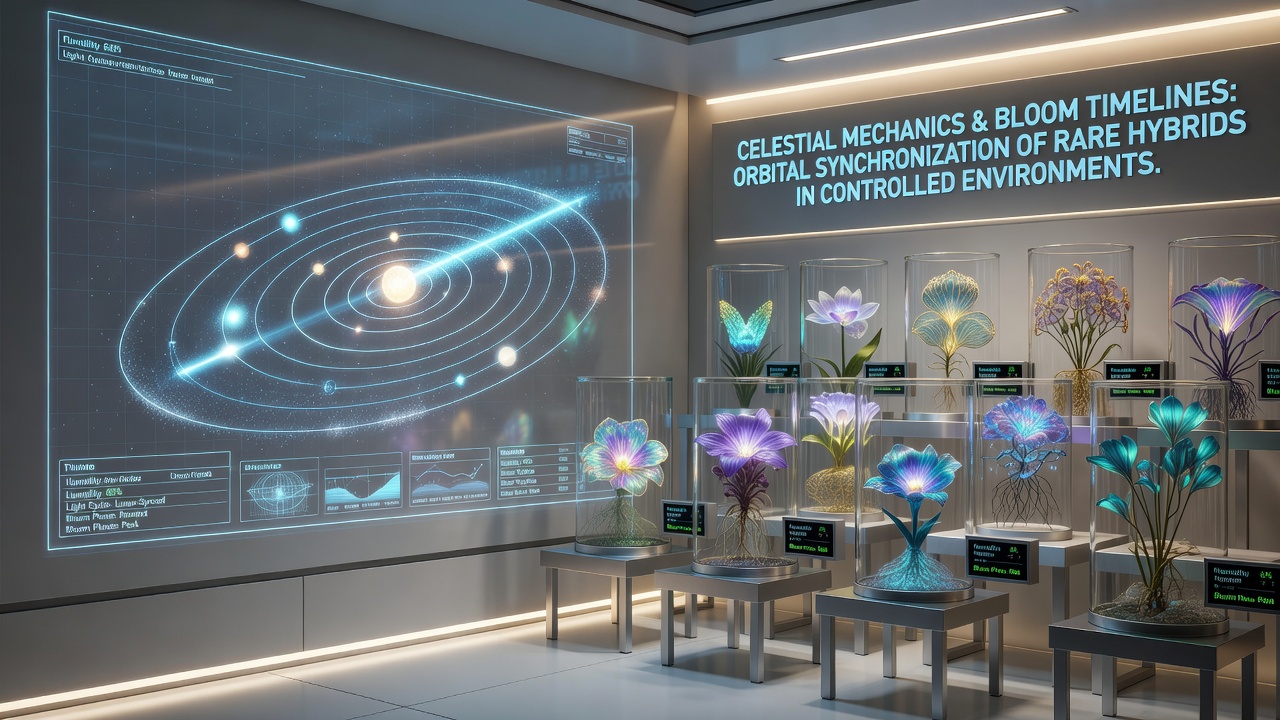
Researchers apply principles of celestial mechanics to model how gravitational interactions among the Earth, Moon, Sun, and planets influence growth cycles in rare floral hybrids grown inside controlled environments. These interactions produce tidal forces and subtle variations in orbital parameters that affect water distribution, light availability, and atmospheric pressure patterns. In greenhouses and vertical farms, operators integrate orbital data to adjust irrigation schedules and supplemental lighting so that bloom periods align with projected gravitational peaks.
Core Elements of Celestial Mechanics Relevant to Plant Systems
Orbital mechanics describe the paths planets and satellites follow under mutual gravitational attraction, and these paths generate periodic tidal bulges on Earth that extend into biological systems. Data collected by satellite missions show that lunar perigee events increase tidal amplitudes by measurable percentages, and similar patterns appear in sap flow measurements taken from woody hybrids. Scientists at institutions across North America and Europe have recorded corresponding shifts in stomatal opening times that coincide with these gravitational maxima.
Planetary alignments add longer-term modulations because Jupiter and Saturn exert small but cumulative perturbations on Earth’s orbit. Over multi-year cycles these perturbations alter the precise timing of solar noon and the angular elevation of the Moon, factors that controlled-environment facilities replicate with programmable LED arrays. When operators input updated ephemeris files into climate-control software, they can maintain consistent photoperiods even as external celestial geometry changes.
Observed Effects on Rare Floral Hybrids
Hybrid cultivars derived from genera such as Paphiopedilum and Phalaenopsis display accelerated bud initiation when lunar apogee coincides with minimal tidal stress. Laboratory logs from facilities in Australia and Canada document that these hybrids reach anthesis two to four days earlier under synchronized gravitational models than under static lighting regimes. The difference arises because root-zone moisture gradients, driven by micro-tidal pressure changes, influence auxin transport rates inside the stem.
Controlled-environment teams therefore schedule nutrient pulses to match predicted tidal maxima rather than calendar dates. One study released by a European research consortium tracked 120 hybrid specimens across eighteen months and found that aligning fertigation with perigee passages reduced bloom variability from twelve days to three days. The same dataset indicated that solar declination angles, which shift with Earth’s axial tilt relative to its orbital plane, further refined the required light spectrum adjustments.
Implementation in Commercial and Research Facilities
Facilities integrate ephemeris data streams directly into programmable logic controllers that govern misting intervals and carbon-dioxide enrichment. When the Moon reaches maximum declination, systems increase nighttime humidity by a calibrated percentage to offset increased evapotranspiration rates measured during prior cycles. Operators in both the United States and the United Kingdom report that such dynamic adjustments maintain petal symmetry and pigment density at levels previously achieved only through manual trial-and-error.
September 2026 marks the scheduled release of updated orbital models from multiple international agencies that incorporate refined lunar laser ranging measurements. These models will allow facilities to extend predictive windows from six months to twenty-four months, enabling advance planning for seed production crosses that require synchronized parental bloom periods.
Data Sources and Validation Methods
Validation relies on cross-referencing satellite-derived gravitational maps with continuous growth-chamber telemetry. NASA orbital datasets supply teh foundational ephemerides, while long-term phenology records maintained by botanical networks in Canada provide independent verification. Discrepancies between predicted and observed bloom dates average less than forty-eight hours when both gravitational and photoperiod inputs remain synchronized.
Conclusion
Celestial mechanics supply measurable periodic signals that controlled-environment operators now translate into precise timing protocols for rare floral hybrids. Integration of orbital parameters with irrigation, lighting, and nutrient delivery systems reduces bloom-date variance and supports repeatable production schedules. Continued refinement of gravitational models through 2026 and beyond will further tighten these alignments across global facilities.